
Conferans
0

Choosing Between Video Bars and Modular Systems

15.08.26 11:27 PM By Brian Zarb

When businesses start planning a video-conferencing room, one of the first equipment decisions is often whether to use an all-in-one video bar or build the room from separate cameras, microphones, speakers and other components.

At first glance, the distinction seems simple.

A video bar combines several functions into one device. A modular meeting-room system separates those functions across individual components.

But choosing between them is not simply a question of small room versus large room.

The better question is:

What does the room actually need the system to do?

KEY TAKEAWAY

A video bar is usually the simpler integrated approach. A modular system provides greater freedom to position and expand individual cameras, microphones, speakers and processing.

Neither is automatically better.

Room depth, seating layout, camera distance, microphone coverage and future requirements should drive the decision.

Video bar vs modular: what actually changes?

A professional video bar typically combines the camera, microphones, speakers and audio processing into one device positioned around the main display.

The attraction is simplicity: fewer separate devices, fewer mounting positions and a cleaner front-of-room installation.

A modular meeting-room system separates those functions. The room may use a dedicated PTZ camera, table or ceiling microphones, separate speakers and additional audio processing.

That creates more design freedom.

The camera can be positioned where it achieves the best view. Microphones can sit closer to the people speaking. Audio can be expanded without necessarily replacing the video system.

The real difference is therefore integration versus flexibility.
Start with camera and audio coverage

Camera resolution matters, but distance matters too.

A wide-angle video bar can work very well when participants sit reasonably close to the display. As the room becomes deeper, people further away occupy a smaller part of the image, and stronger optical camera reach can become useful.

That is where a separately positioned PTZ camera may make more sense.

Audio can be even more important.

A camera may still see someone at the opposite end of a long table, but the microphone still has to capture that person clearly enough for remote participants to understand them.

In the right room, the microphones built into a video bar may provide the coverage required. Longer tables or more demanding layouts can benefit from additional microphones positioned further into the room.

This creates an important middle ground:

video bar + additional microphone coverage.

A room does not automatically need to become fully modular simply because the built-in microphones are not enough.
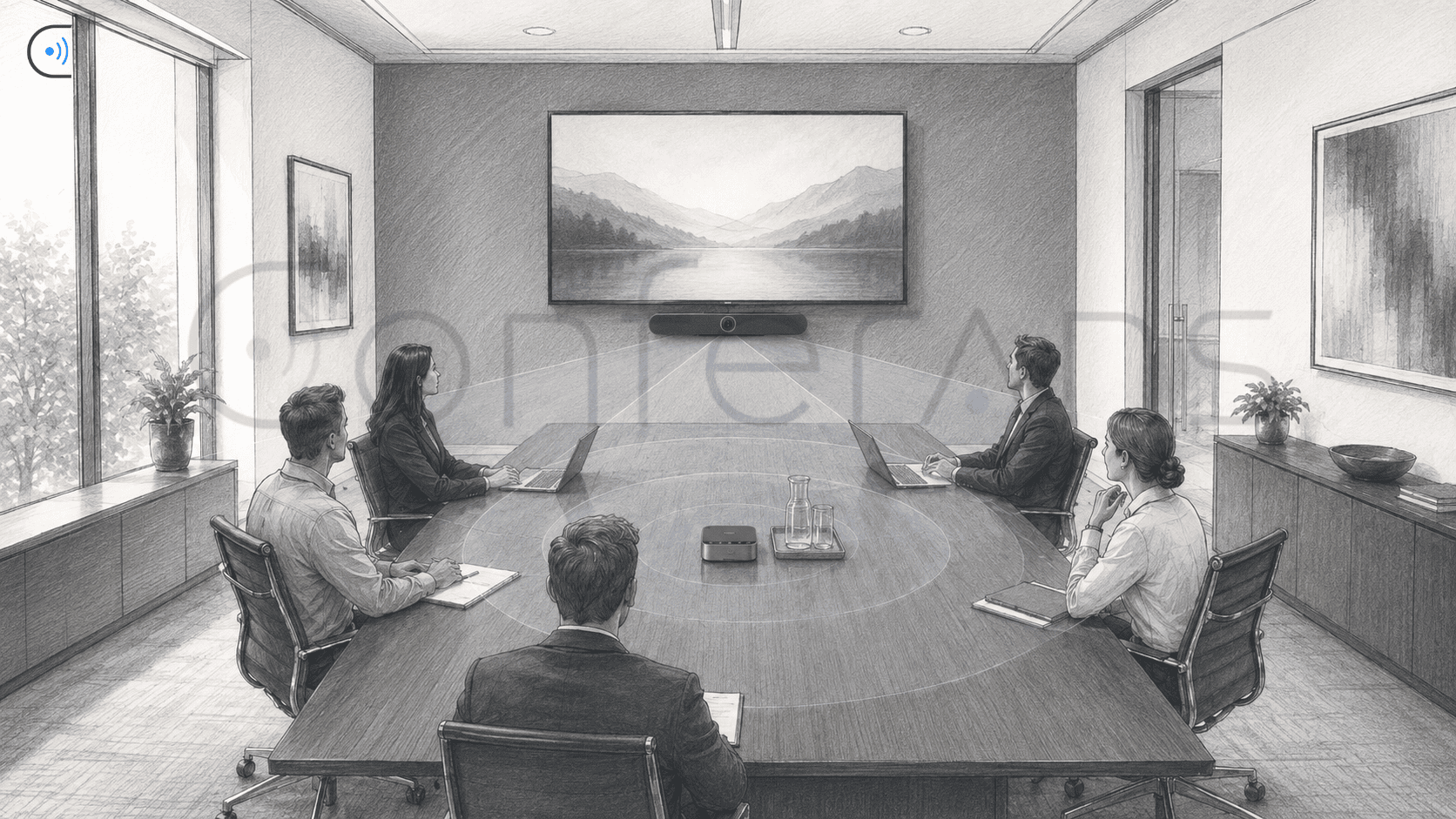
Same professional meeting room comparing an all-in-one video bar with a modular setup using a separate camera, microphones and speakers.

Room shape matters as much as capacity

Consider two meeting rooms that both seat ten people.

One is relatively short, with the complete table close to the display. The other is long and narrow, with the final seats considerably further away.

Both are ten-person rooms.

They should not automatically receive the same conferencing system.

The first may work extremely well with an appropriate video bar. The second may benefit from stronger camera reach and microphones distributed further into the room.

That is why seating capacity should be treated as a starting point, not the complete specification.

If you are still defining the room itself, start with our Meeting Room Size Guide.

Simplicity versus flexibility

A video bar is attractive because it reduces complexity.

Typical advantages include:
  • fewer separate devices;
  • less cabling;
  • fewer mounting positions;
  • quicker deployment;
  • simpler troubleshooting;
  • and a cleaner front-of-room installation.
A modular system introduces more components, but those components can be selected, positioned and upgraded independently.

That becomes valuable when the room needs:
  • stronger optical camera reach;
  • additional audio processing;
  • multiple cameras;
  • deeper AV integration;
  • or greater room for future expansion.
  • separately positioned speakers;
  • microphones around a long table or in the ceiling;
The extra complexity should achieve something useful.

There is little benefit in making a straightforward meeting room complicated simply because more equipment is available.
he physical AV architecture and the way users join meetings are separate decisions.

A video-bar or modular room can still support different meeting workflows and connection methods.

If you are still deciding how laptops and room equipment should work together, read Choosing a BYOM Setup: What Should You Consider for Your Meeting Room?

A video bar can make sense when:

  • participants sit reasonably close to the front of the room;
  • built-in or expandable microphones can cover the table;
  • simple deployment is a priority;
  • the business wants fewer separate devices to manage;
  • and the room does not require highly customised AV integration.
  • the integrated camera provides enough framing and reach;
This can include small rooms, medium rooms and, with the right room geometry and equipment, some larger meeting spaces.

For a practical example of an integrated room approach, explore our Medium Meeting Rooms options.

A modular system becomes more attractive when:

  • the room is particularly deep or unusually shaped;
  • microphones need to be positioned around the room;
  • separate speakers are beneficial;
  • more than one camera may be required;
  • existing AV equipment needs to be retained;
  • or future expansion is an important part of the design.
  • stronger optical camera reach is required;
These are design requirements, not rigid room-size rules.

A modular system is not automatically the premium answer, just as a video bar is not automatically the basic answer.

The right system is the one that covers the complete room properly without introducing complexity that serves no useful purpose.

BEFORE YOU CHOOSE

Before choosing between a video bar and a modular meeting-room system, answer five questions:

  1. How large and deep is the room?
  2. Where will people actually sit?
  3. How far does the camera need to see clearly?
  4. Where does microphone coverage need to reach?
  5. Does the room need to expand or change over time?

Once those answers are clear, the equipment architecture becomes considerably easier to define.

How Conferans approaches the decision

At Conferans, we do not treat video bars and modular systems as competing technologies where one is always better.

They solve different room-design problems.

For many meeting rooms in Malta, an appropriate professional video bar combined with sufficient microphone coverage can provide a clean, practical system without unnecessary complexity.

For deeper boardrooms and more specialised spaces, the design can move toward separately positioned cameras, table or ceiling microphones, dedicated speakers and additional audio processing where the room actually requires it.

The objective is not to install the most equipment possible.

It is to install enough equipment to cover the complete room properly — without adding complexity the business does not need.
If you are still deciding where your room sits in the overall meeting-room range, start with our Meeting Room Size Guide or explore our Meeting Room Solutions.

Smarter meeting rooms. Clearer conversations.

Not sure which connection method fits your room?

Tell us how the room is used, which meeting platforms matter and what equipment is already installed. We can help narrow down whether wireless presentation, wired or wireless BYOM, or a combination makes the most sense.

Items have been added to cart.
One or more items could not be added to cart due to certain restrictions.
Added to cart
Quantity updated
- An error occurred. Please try again later.
Deleted from cart
- Can't delete this product from the cart at the moment. Please try again later.